Exoscale SKS Review: Everything Works, Except the Security Model
Exoscale SKS provisions a Kubernetes cluster in 2 minutes, has great support on a trial account, and lets you choose your CNI. But the API endpoint is always public with no IP restrictions. Full OpenTofu setup and fio benchmarks included.
Exoscale’s managed Kubernetes (SKS) provisioned a 3-node cluster in under 2 minutes, assigned a load balancer IP in 6 seconds, and their support answered a trial-account ticket in 6 minutes. Then I looked at the security model and found there’s no private cluster mode, no API IP restrictions, and kubelet is open to 0.0.0.0/0. In 2026.
That’s the tension with Exoscale: the developer experience is genuinely excellent, but the networking story has gaps that make it less suited for certain production workloads. Here’s the full breakdown.
Exoscale is a Swiss cloud provider owned by A1 Digital (A1 Telekom Austria Group), operating across 8 European zones in Switzerland, Germany, Austria, Bulgaria, and Croatia. Think of them as the European alternative that actually feels modern, not like a rebadged OpenStack console.
What I Tested
- Control Plane: Starter tier (free, no SLA)
- Nodes: 3x Standard Medium (2 vCPU, 4 GB RAM, 50 GB disk)
- Region: DE-FRA-1 (Frankfurt, Germany)
- Kubernetes Version: 1.35.0
- CNI: Cilium
- Addons: Exoscale Cloud Controller, Container Storage Interface, Metrics Server
- Automation: OpenTofu with the official Exoscale provider
Total estimated cost: ~€91.53/month (3x €30.51/node). Control plane is free on the Starter tier. The Pro tier adds €30.44/month for SLA and dedicated support.
I tested on a trial account with €150 free credit, courtesy of a friendly Redditor who shared a promo code. That’s enough for several weeks of running a 3-node cluster.
The cluster runs ArgoCD for GitOps with an app-of-apps pattern, all provisioned through a single OpenTofu repo.
The Good
Fast Cluster Provisioning
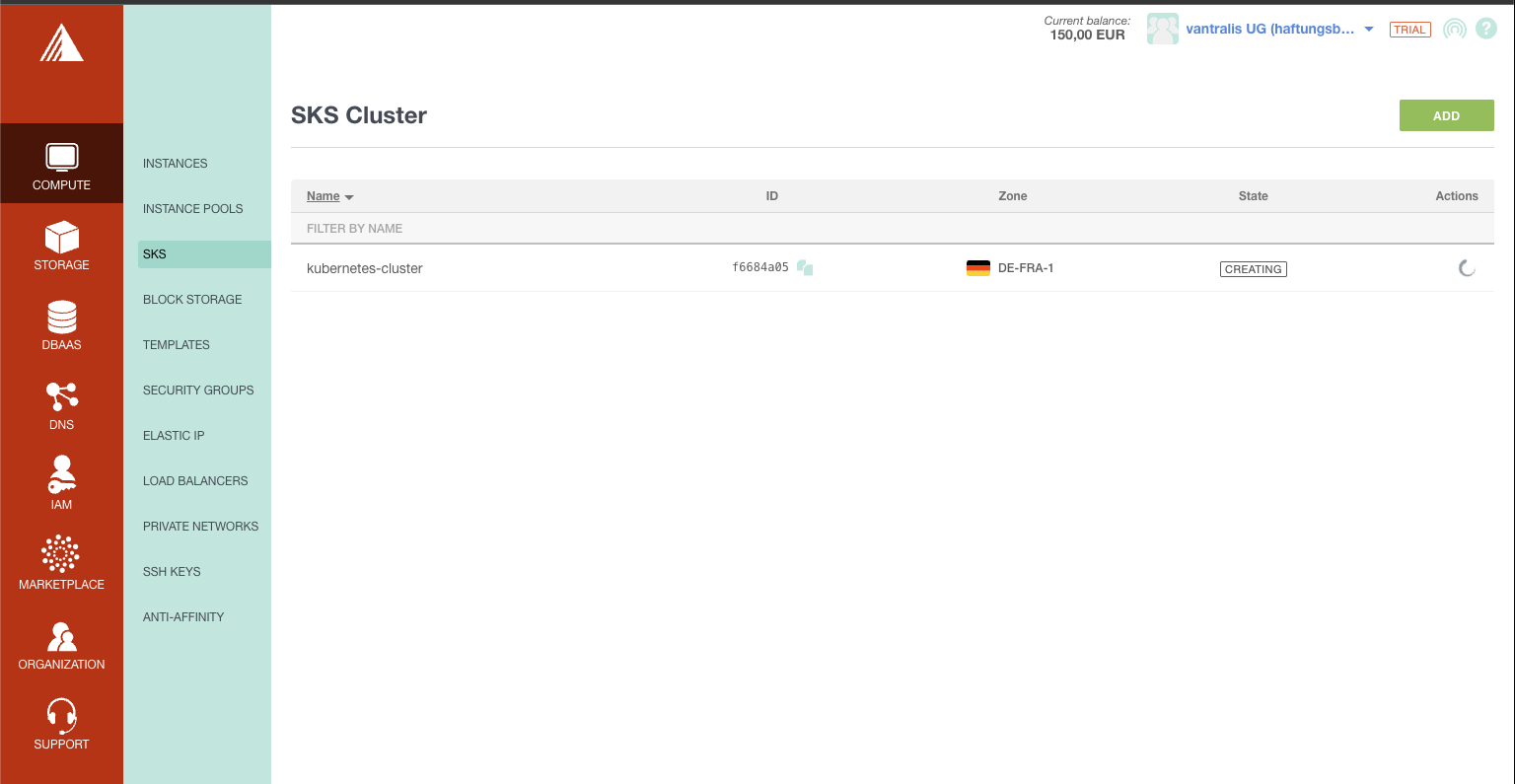
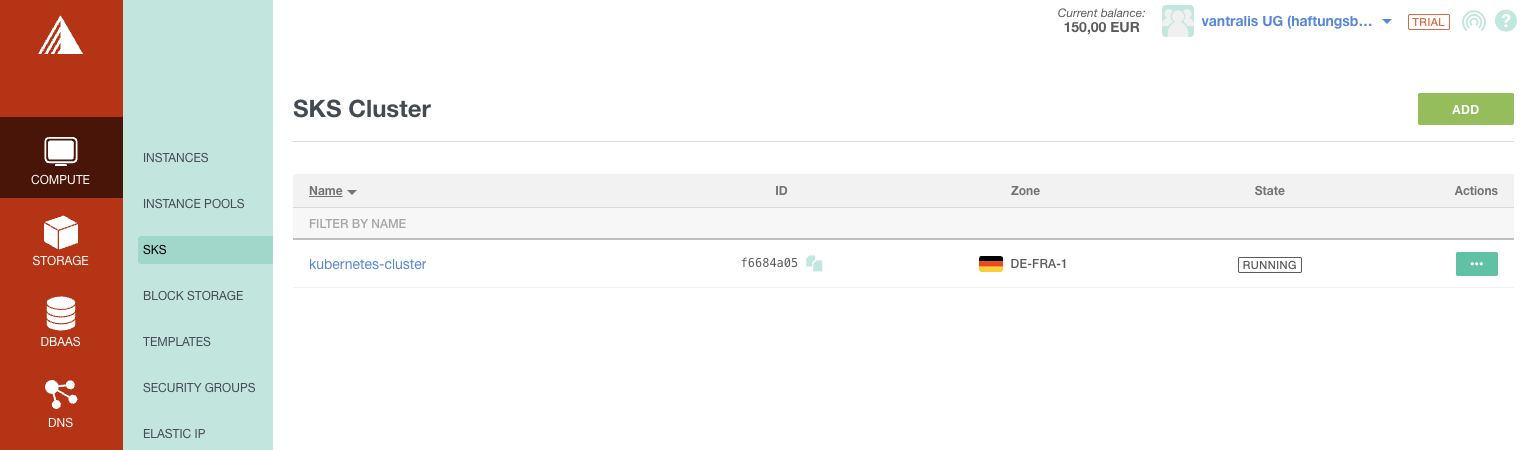
The SKS cluster went from CREATING to RUNNING in under 2 minutes. I’ve tested OVHcloud (also fast), Infomaniak (where nodes sometimes wouldn’t come up at all), and Hetzner + Talos (fast but DIY). Exoscale was the fastest managed offering.
Clean Console and Cluster Management
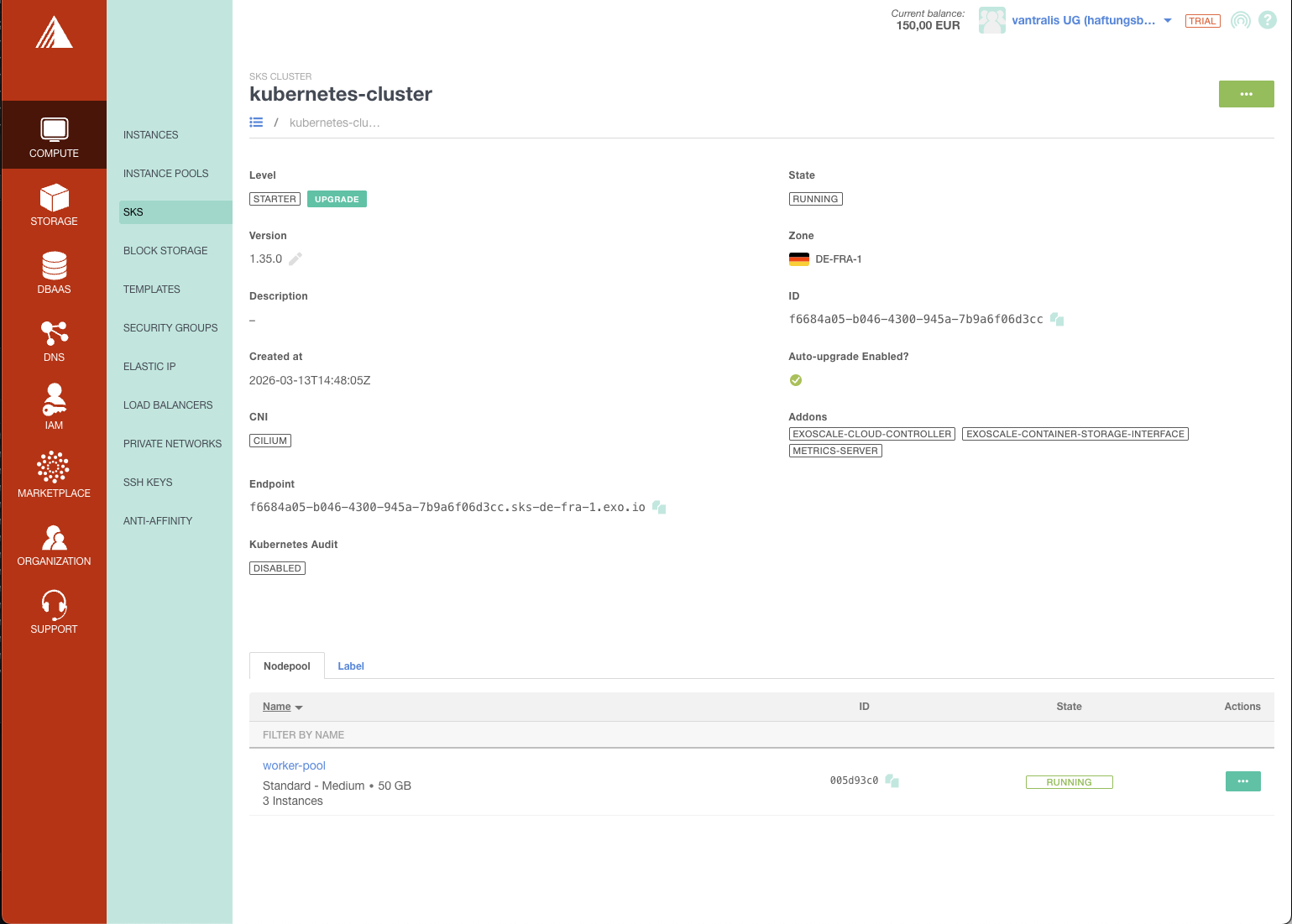
The cluster detail page shows everything at a glance: version, zone, CNI, addons, endpoint, and node pool status. No clicking through five tabs to find basic information.
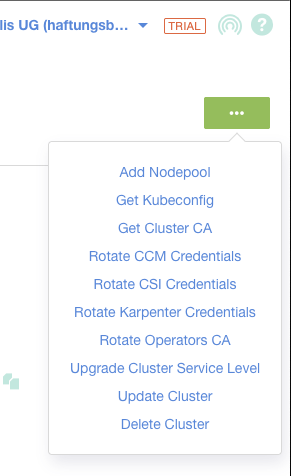
The actions menu gives you quick access to kubeconfig download, credential rotation, and cluster management - all in one place.
You Choose Your CNI
Unlike OVHcloud and Infomaniak where the CNI is decided for you, Exoscale lets you choose between Cilium and Calico at cluster creation time. I went with Cilium for its eBPF-based networking, but having the option is valuable if your team has existing Calico expertise or specific NetworkPolicy requirements.
The trade-off: your security group rules must match the CNI you choose. Cilium needs ports 8472 (VXLAN), 4240 (health), and ICMP. Calico needs port 4789 (VXLAN). Get it wrong and your pods can’t communicate.
Anti-Affinity Groups for HA
Exoscale supports anti-affinity groups as a first-class resource. This spreads your worker nodes across different physical hypervisors, so a single hardware failure doesn’t take out all your nodes at once.
resource "exoscale_anti_affinity_group" "workers" {
  name        = "${var.cluster_name}-workers"
  description = "Anti-affinity for ${var.cluster_name} worker nodes"
}

resource "exoscale_sks_nodepool" "workers" {
  # ...
  anti_affinity_group_ids = [exoscale_anti_affinity_group.workers.id]
}
This is free and has no downside. Neither OVHcloud nor Infomaniak expose this as a configurable option. It’s a small thing, but it shows Exoscale thinks about operational concerns.
Surprisingly Good Support
I opened a ticket about storage classes on a trial account and got a knowledgeable response from Benoit at Exoscale support in 6 minutes.
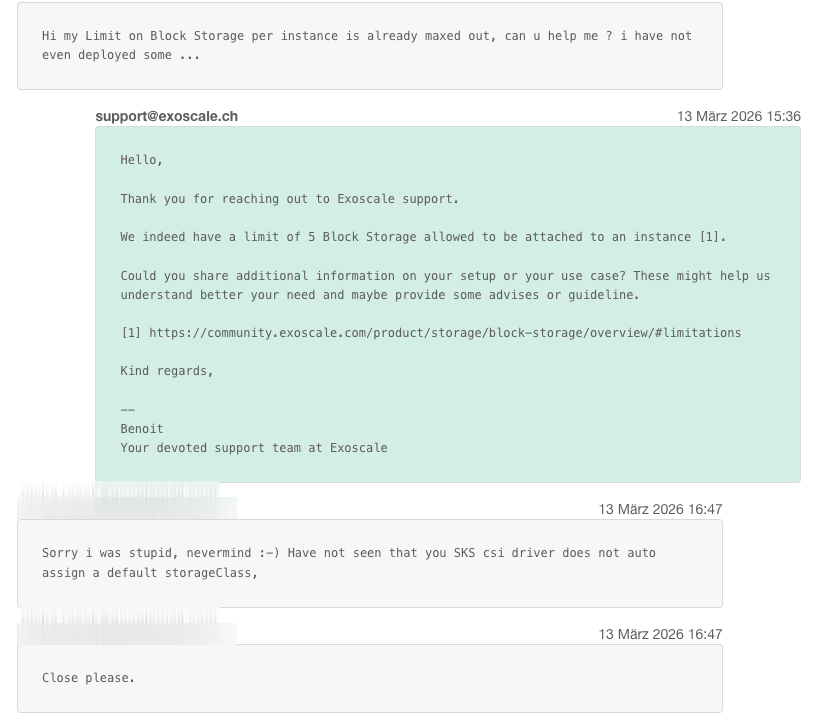
Six minutes. On a trial account. Most providers make you wait days, if they respond at all.
DBaaS Built In
Exoscale offers managed databases (DBaaS) directly in their console - PostgreSQL, MySQL, Redis, Kafka, OpenSearch, and Grafana. That’s a clear advantage over Infomaniak (MySQL only). Having managed PostgreSQL alongside your Kubernetes cluster means one fewer vendor and one fewer billing relationship.
Six GPU Families Up to 288 vCPU
Exoscale offers GPU 2, GPU 3, A30, 3080 Ti, A5000, and RTX 6000 PRO as node pool instance types. The RTX 6000 PRO goes up to 288 vCPUs and 960 GB RAM.
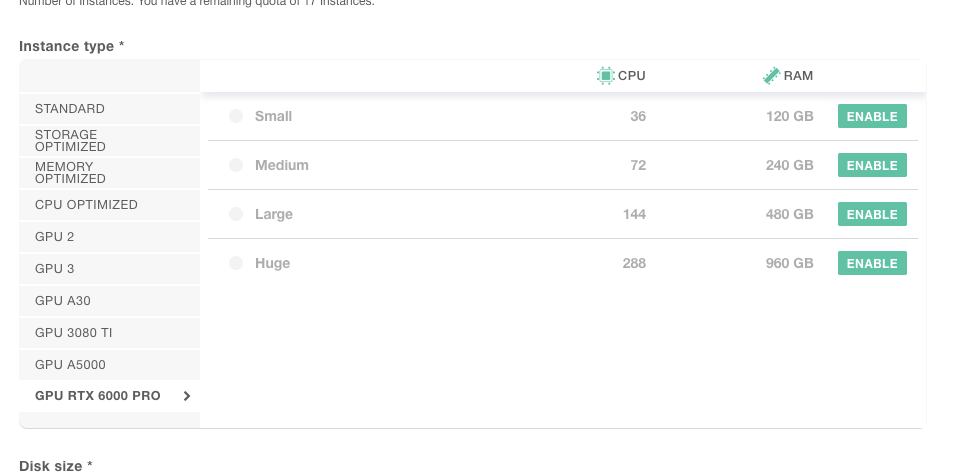
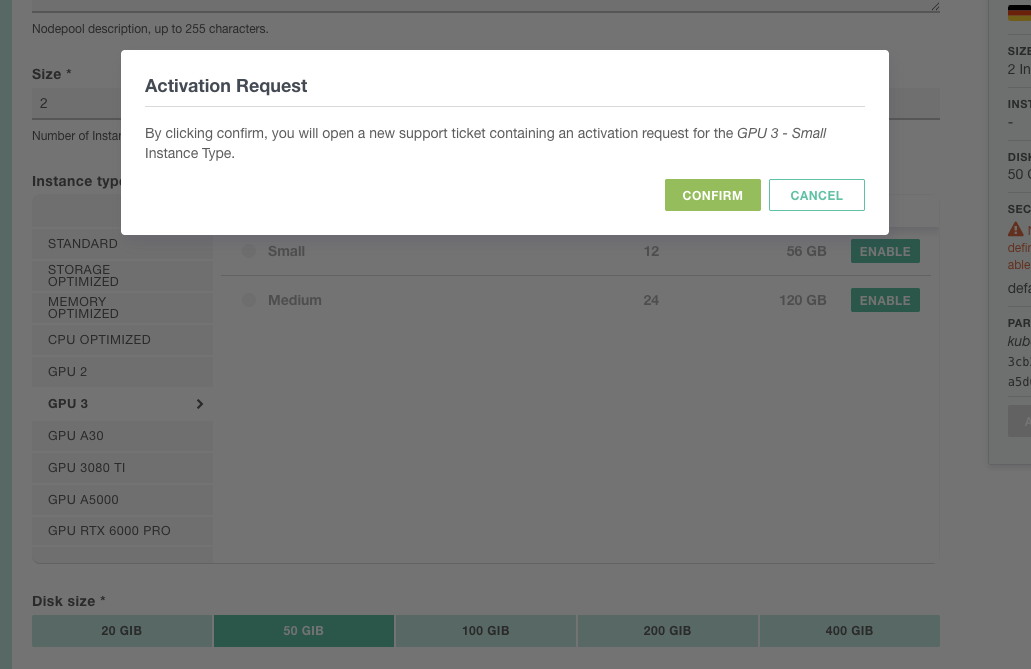
GPU instances require an activation request (support ticket), which makes sense for capacity planning.
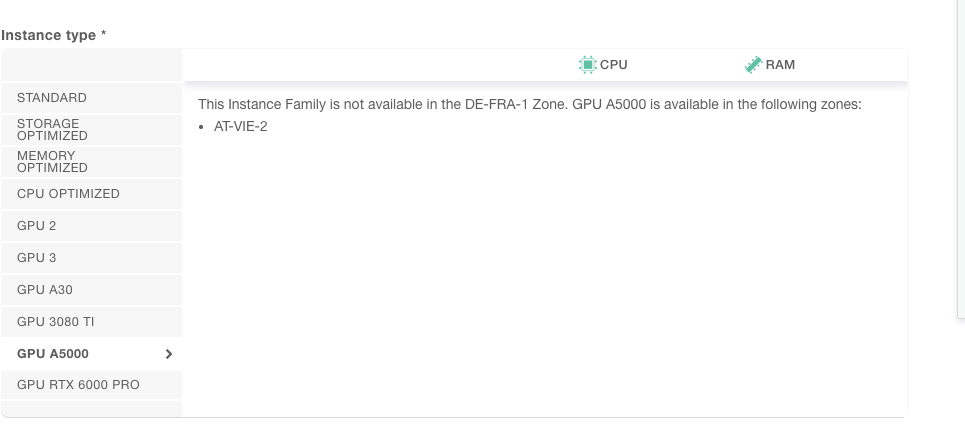
Zone availability varies - the A5000, for example, is only available in AT-VIE-2 (Vienna), not in Frankfurt.
See our GPU cloud instances audit for a full comparison across providers.
Eight Zones Across Five Countries
| Zone | Location |
|---|---|
ch-gva-2 | Geneva, Switzerland |
ch-dk-2 | Zurich, Switzerland |
de-fra-1 | Frankfurt, Germany |
de-muc-1 | Munich, Germany |
at-vie-1 | Vienna, Austria |
at-vie-2 | Vienna, Austria (2nd) |
bg-sof-1 | Sofia, Bulgaria |
hr-zag-1 | Zagreb, Croatia |
Useful for latency-sensitive deployments or data residency requirements across the DACH region and Southeastern Europe. Infomaniak has 1 zone. OVHcloud has broader coverage (10+ including France and Poland) but no presence in Austria, Bulgaria, or Croatia.
Load Balancer Provisioning in Seconds
Deploying Traefik as a LoadBalancer service triggered Exoscale’s Cloud Controller Manager, and a public IP was assigned within seconds. The events tell the story: EnsuredLoadBalancer at 6 seconds.
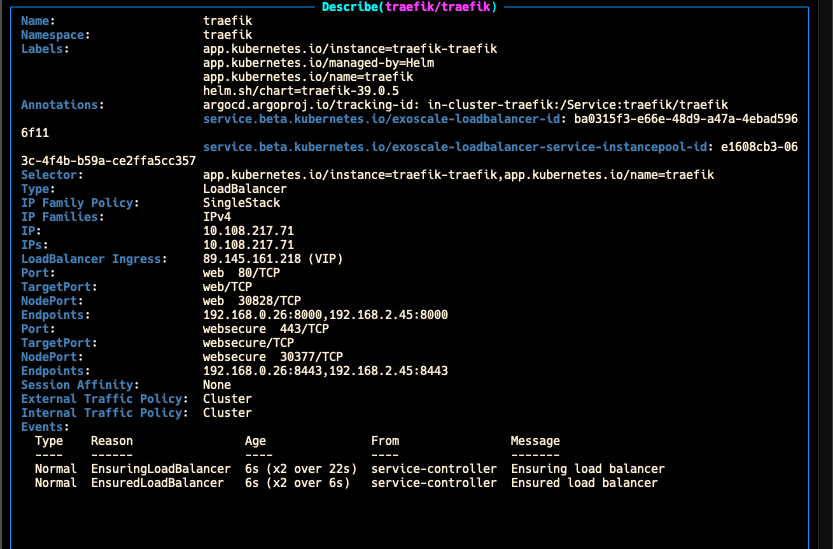
No manual configuration, no waiting. Traefik was deployed via ArgoCD (Helm chart v39.0.5), and the CCM handled the rest. OVHcloud’s Octavia load balancer took a few minutes to provision in my test. Exoscale did it in 6 seconds.
Readable Instance Type Naming
A small but appreciated detail: Exoscale uses standard.medium, standard.large, memory.huge instead of OVHcloud’s cryptic d2-8 or Infomaniak’s a4-ram8-disk80-perf1. You can actually read the instance type and know what you’re getting.
The Not-So-Good
No Private Clusters, No API Restrictions, No Network Isolation
This is the biggest limitation. The Kubernetes API endpoint on Exoscale SKS is always public. There is no private cluster mode, no API IP allowlisting, and no field in the API, CLI, console, or Terraform provider to restrict access. I verified this against the Exoscale API v2 schema, Terraform provider docs, and community documentation. This is a confirmed platform limitation, not a missing feature in my config.
Unlike OVHcloud’s IP restrictions (which let you lock the API to specific CIDRs) or hyperscalers’ private endpoints, anyone who obtains your kubeconfig can reach your API server from anywhere in the world. This isn’t just a compliance concern: a publicly reachable API endpoint means a leaked credential (a kubeconfig in a CI log, a developer’s laptop compromise, a misconfigured Git repo) could provide access to the cluster from anywhere. With a private endpoint or IP allowlist, leaked credentials have limited impact since they can’t be used from outside the network.
And the private networking story doesn’t help either. Exoscale private networks are pure Layer 2 - essentially a virtual switch. No routing, no NAT, no internet gateway. Attaching one to a node pool only adds an extra NIC; it doesn’t replace the public interface. The details:
- The CNI overlay (Cilium/Calico) runs over the public interface, not the private network
- Security groups don’t apply to private network traffic - it’s completely unfiltered
- The API has
public-ip-assignment: nonebut it’s not exposed in the Terraform provider (v0.68.0) - Without public IPs, nodes can’t pull images or reach the Exoscale API unless you build a NAT gateway VM yourself
The compensating controls are limited: short-lived kubeconfig certificates (30-day TTL, already configured), OIDC integration, RBAC, and audit logging. That’s defense-in-depth, not network isolation. For strict compliance environments, this may not pass audit. Private clusters and API access controls are increasingly expected from managed Kubernetes offerings.
Kubelet Port Open to the World
The official Exoscale docs require 0.0.0.0/0 on port 10250 for kubelet access. This is because the SKS control plane IPs are not published as a fixed CIDR range, so you can’t lock it down to just the control plane.
resource "exoscale_security_group_rule" "kubelet" {
  security_group_id = exoscale_security_group.cluster.id
  type              = "INGRESS"
  protocol          = "TCP"
  cidr              = "0.0.0.0/0"
  start_port        = 10250
  end_port          = 10250
  description       = "SKS kubelet"
}
Other providers handle this internally. Opening kubelet to the internet is not ideal, even though the kubelet API requires authentication.
No Default StorageClass
Exoscale CSI creates two StorageClasses but neither is set as default:
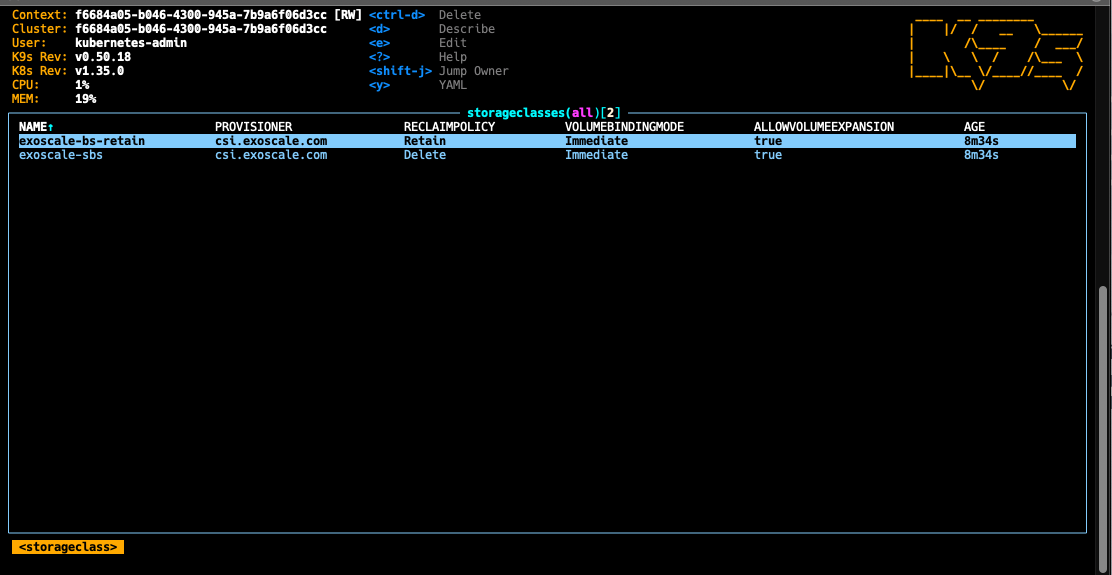
| Storage Class | Reclaim Policy | Default? |
|---|---|---|
exoscale-bs-retain | Retain | No |
exoscale-sbs | Delete | No |
Many Helm charts (CNPG, Vault, Keycloak) expect a default StorageClass to exist. If you’re using GitOps, the right fix is to set the default in your cluster-essentials repo - either as a Kustomize patch or a Helm values override that references exoscale-sbs as the storageClassName. That way it’s declarative and survives cluster recreation.
As a quick fix for manual testing:
kubectl patch storageclass exoscale-sbs \
  -p '{"metadata":{"annotations":{"storageclass.kubernetes.io/is-default-class":"true"}}}'
I actually opened a support ticket about this thinking something was broken before realizing it’s by design. If you’re deploying charts that default to an empty storageClassName, you’ll hit this on day one.
No RWX Volumes
Like OVHcloud, all Exoscale storage classes are ReadWriteOnce (RWO) only. If you need volumes mounted by multiple pods simultaneously (ReadWriteMany / RWX) - common for CMS platforms, shared uploads, or multi-replica apps with shared state - you have three options:
- Longhorn - Install Longhorn in your cluster. It discovers node disks, distributes and replicates volumes, and supports RWX via NFS. Also handles snapshots and backups to Exoscale SOS (S3-compatible). This is probably the best self-managed option.
- NFS server on block storage - Run your own NFS server on top of a block storage volume. Works but adds operational overhead.
- Object Storage via Mountpoint - Use Exoscale SOS with AWS Mountpoint for S3 as a Kubernetes volume. Good for read-heavy workloads, not suitable for high-IOPS.
Exoscale mentions that a managed RWX service is “in our roadmap” - but that blog post is from March 2025 and there’s been no update since. Don’t count on it. Plan your storage architecture accordingly before deploying stateful workloads.
Block Storage Performance: The Benchmark Truth
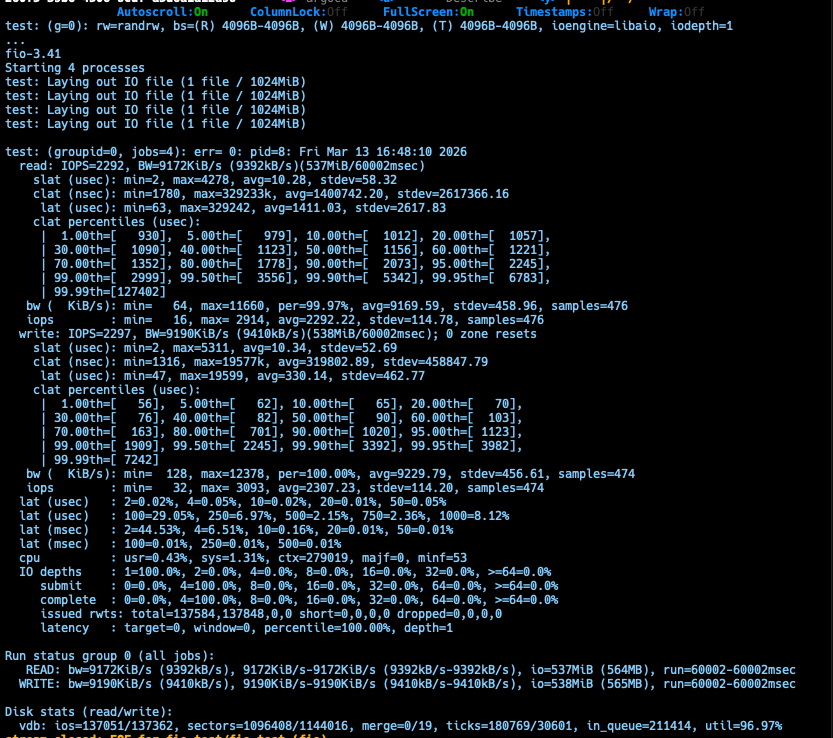
I ran fio (3.41, iodepth=32, numjobs=4, 3 independent runs) against Exoscale’s block storage. Exoscale advertises 5,000 IOPS per volume - here’s what I actually measured:
| Test | Advertised | Measured (realistic) | Notes |
|---|---|---|---|
| Random 4K RW IOPS | 5,000 | ~3,800-4,000 combined | 5,000 is a burst ceiling, not sustained |
| Sequential Read | n/a | ~515 MB/s | Stable across all runs, competitive |
| Sequential Write | n/a | 773-843 MB/s (headline) | Write cache inflated - min/max spread of 10-3,952 MB/s |
| Write p99.99 latency | n/a | 2.4-2.6 seconds | Reproducible across all runs |
| Read p99.99 latency | n/a | 860 ms - 1 s | Random RW |
The write tail latency is the real story. The p50 at 3.7 ms looks great, but 0.01% of writes stall for 2.5+ seconds. That’s not an anomaly - it reproduced across every run. The sequential write bandwidth is also misleading: the min/max spread exposes burst-then-drain cache behaviour.
For comparison, Infomaniak caps at 500-1,000 IOPS - Exoscale is roughly 4-8x faster for random I/O. But for write-heavy database workloads, the p99.99 tail latency means you should use Exoscale’s own Managed Database Service instead. General web apps, stateless-ish Kubernetes PVCs, and backup workloads will be fine.
Provider Still v0.x
The Exoscale Terraform provider is at v0.68.0 (March 2026). Still no 1.0 release after years. This means breaking changes can happen between minor versions. Pin your version carefully and test upgrades.
Short-Lived Kubeconfig
The kubeconfig is generated as a separate resource with a 30-day certificate TTL. This is actually more secure than long-lived tokens (which OVHcloud and Infomaniak use), but it’s operationally different:
resource "exoscale_sks_kubeconfig" "admin" {
  cluster_id  = exoscale_sks_cluster.cluster.id
  zone        = exoscale_sks_cluster.cluster.zone
  user        = "kubernetes-admin"
  groups      = ["system:masters"]
  ttl_seconds = 2592000  # 30 days
}
If you’re using this kubeconfig in CI/CD, it will break after 30 days. You need to either re-run tofu apply to refresh it, configure early_renewal_seconds, or use Kubernetes service account tokens for long-lived access.
The Setup: OpenTofu From Scratch
I’ve published the complete OpenTofu setup on GitHub. Here are the key parts.
IAM and API Keys
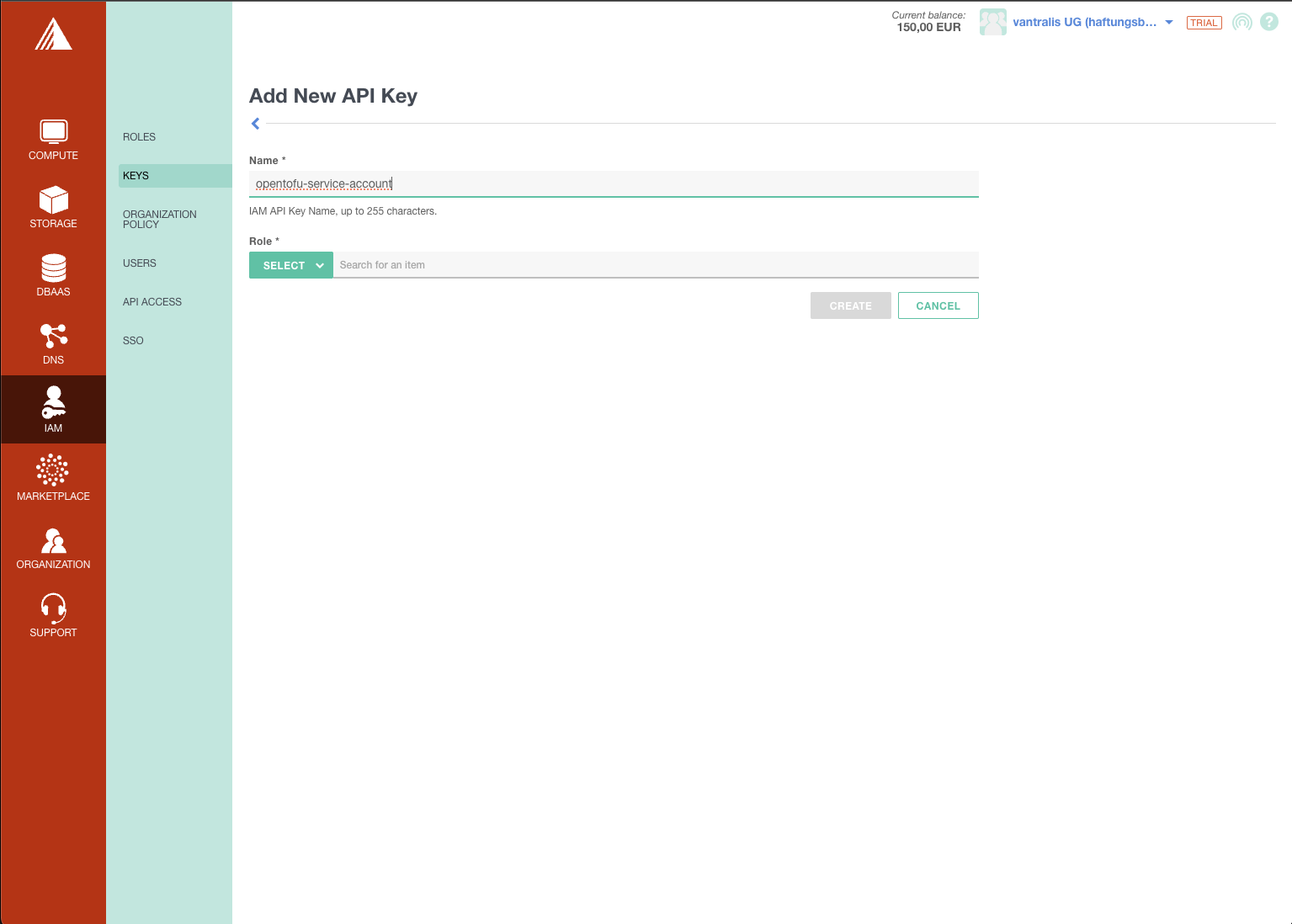
First, create an API key in the Exoscale console under IAM > Keys. I created a dedicated opentofu-service-account key:
Provider Configuration
The Exoscale provider is minimal. The Helm provider connects through the kubeconfig by parsing the YAML directly:
terraform {
  required_version = ">= 1.6.0"

  required_providers {
    exoscale = {
      source  = "exoscale/exoscale"
      version = "~> 0.68.0"
    }
    helm = {
      source  = "hashicorp/helm"
      version = "~> 3.1.0"
    }
  }
}

provider "exoscale" {
  key    = var.exoscale_api_key
  secret = var.exoscale_api_secret
}

provider "helm" {
  kubernetes = {
    host                   = yamldecode(exoscale_sks_kubeconfig.admin.kubeconfig)["clusters"][0]["cluster"]["server"]
    cluster_ca_certificate = base64decode(yamldecode(exoscale_sks_kubeconfig.admin.kubeconfig)["clusters"][0]["cluster"]["certificate-authority-data"])
    client_certificate     = base64decode(yamldecode(exoscale_sks_kubeconfig.admin.kubeconfig)["users"][0]["user"]["client-certificate-data"])
    client_key             = base64decode(yamldecode(exoscale_sks_kubeconfig.admin.kubeconfig)["users"][0]["user"]["client-key-data"])
  }
}
The kubeconfig parsing is more involved than OVHcloud’s approach (where kubeconfig_attributes gives you direct access), but it works.
Cluster and Node Pool
The cluster definition is clean. Note that exoscale_ccm and exoscale_csi are opt-in - unlike OVHcloud where they’re pre-installed:
resource "exoscale_sks_cluster" "cluster" {
  zone          = var.zone
  name          = var.cluster_name
  version       = var.kubernetes_version
  cni           = var.cni
  service_level = var.service_level
  auto_upgrade  = var.auto_upgrade
  exoscale_ccm  = true
  exoscale_csi  = true
}

resource "exoscale_sks_nodepool" "workers" {
  zone          = exoscale_sks_cluster.cluster.zone
  cluster_id    = exoscale_sks_cluster.cluster.id
  name          = "worker-pool"
  instance_type = var.instance_type
  size          = var.node_count
  disk_size     = var.disk_size

  security_group_ids      = [exoscale_security_group.cluster.id]
  anti_affinity_group_ids = [exoscale_anti_affinity_group.workers.id]
}
Security Groups (CNI-Conditional)
This is where Exoscale differs from OVHcloud and Infomaniak, which handle network security internally. You must define security groups explicitly, and the rules depend on your CNI choice. The kubelet rule (open to 0.0.0.0/0, covered above) is always required. The CNI-specific rules use user_security_group_id to scope traffic to nodes in the same security group:
# Cilium-specific (conditional)
resource "exoscale_security_group_rule" "cilium_vxlan" {
  count = var.cni == "cilium" ? 1 : 0

  security_group_id      = exoscale_security_group.cluster.id
  type                   = "INGRESS"
  protocol               = "UDP"
  user_security_group_id = exoscale_security_group.cluster.id  # Intra-cluster only
  start_port             = 8472
  end_port               = 8472
}
That user_security_group_id pattern means VXLAN and health-check ports are only open between cluster nodes, not to the world. Good design.
ArgoCD Bootstrap
ArgoCD is deployed via Helm with an app-of-apps pattern pointing to a GitHub repository:
resource "helm_release" "argocd" {
  name             = "argocd"
  repository       = "https://argoproj.github.io/argo-helm"
  chart            = "argo-cd"
  version          = "9.4.6"
  namespace        = "argocd"
  create_namespace = true

  values = [yamlencode({
    configs = {
      repositories = {
        argocd-cluster-essentials = {
          url = "https://github.com/${var.github_org}/argocd-cluster-essentials"
        }
      }
    }
  })]

  depends_on = [
    exoscale_sks_cluster.cluster,
    exoscale_sks_nodepool.workers,
  ]
}
What You Get
After tofu apply, you have a running cluster with ArgoCD ready for GitOps:
tofu output -raw kubeconfig > kubeconfig
export KUBECONFIG=./kubeconfig
kubectl get nodes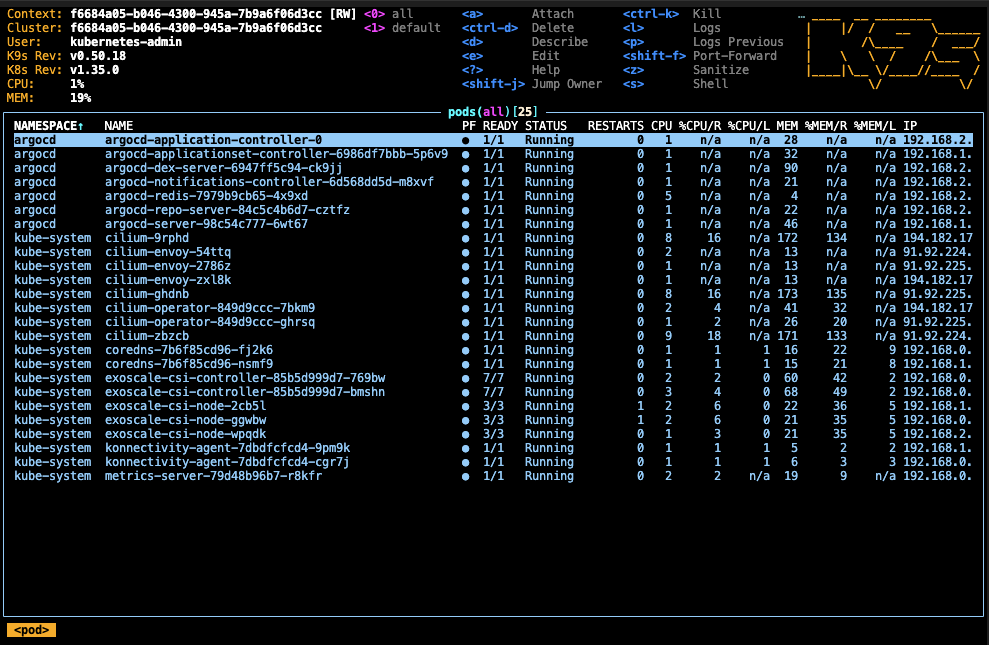
Resource Quotas
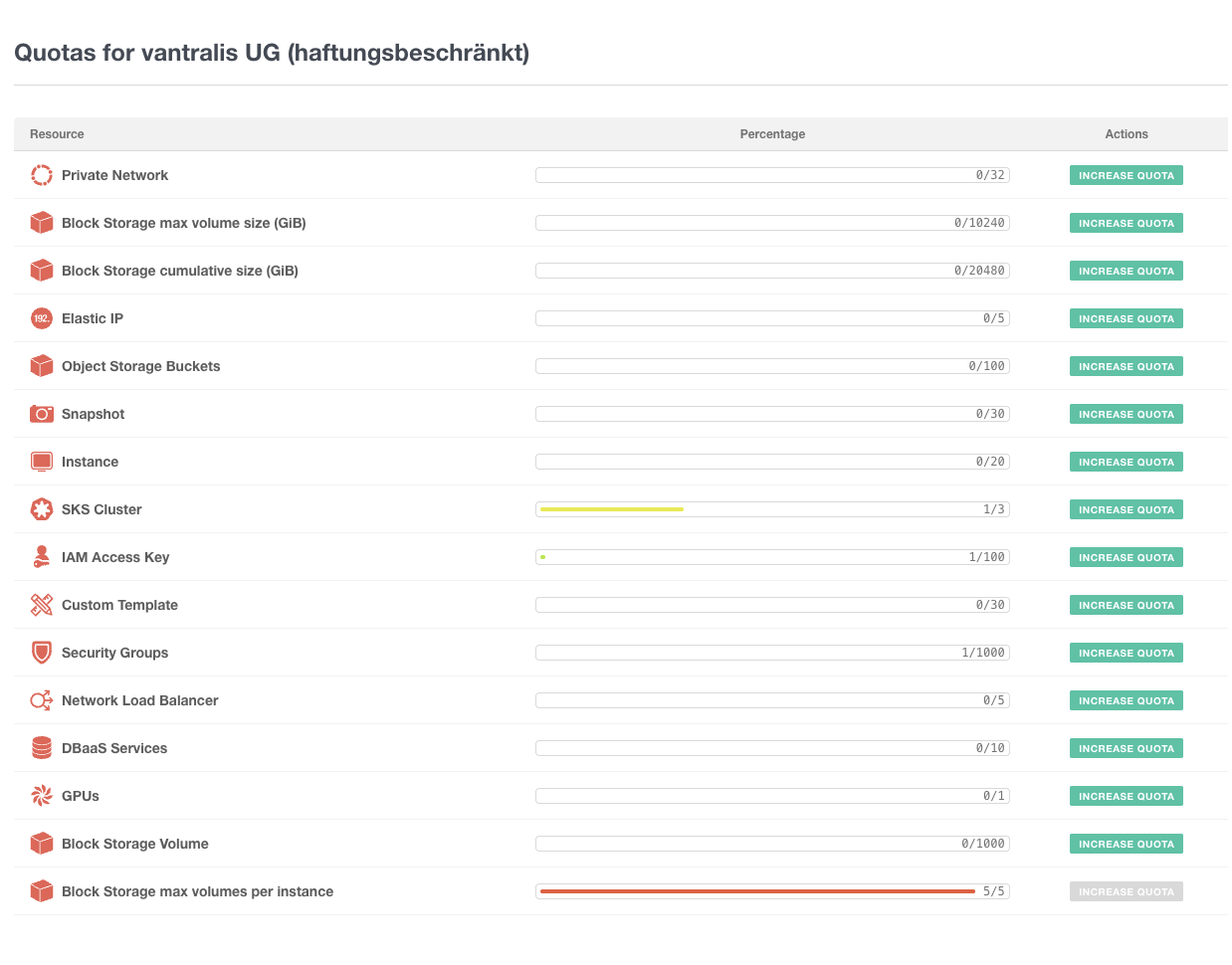
The Exoscale console gives you a clear view of all resource quotas. Worth checking before scaling up:
Exoscale vs OVHcloud vs Infomaniak
| Feature | Exoscale | OVHcloud | Infomaniak |
|---|---|---|---|
| Control plane cost | Free (Starter) / €30.44 (Pro) | Free | Free (Shared) / €25.95 (Dedicated) |
| CNI choice | Cilium or Calico | Fixed (managed) | Fixed (Cilium) |
| Private cluster | No | Yes (vRack) | No |
| API IP restrictions | No | Yes | No |
| Anti-affinity groups | Yes | No | No |
| Short-lived kubeconfig | Yes (30 days) | No (long-lived) | No (long-lived) |
| GPU instances | Yes (6 families) | Yes (limited) | No |
| Managed DBaaS | PostgreSQL, MySQL, Redis, Kafka, OpenSearch | PostgreSQL, MySQL, MongoDB, Redis, Kafka | MySQL only |
| Provider maturity | v0.68.x | v2.11.x (stable) | v1.x (stable) |
| EU zones | 8 (CH, DE, AT, BG, HR) | 10+ (FR, DE, PL, UK, CA) | 1 (CH) |
| Egress pricing | Tiered (free allowance per instance) | Free (EU/NA) | Included |
| Support speed | Fast (even on trial) | Standard | Not tested |
| Storage classes | 2 (no default) | 6 (with LUKS encryption) | 2 tiers (500-1000 IOPS) |
Who Is Exoscale SKS For?
Great fit for:
- Teams who want CNI flexibility (Cilium vs Calico)
- GPU/ML workloads on European infrastructure
- Projects that need managed databases alongside Kubernetes
- DACH-region deployments (Switzerland, Germany, Austria zones)
- Development and staging environments with fast provisioning
- Teams comfortable with OpenTofu/Terraform automation
Consider alternatives if:
- You need private clusters or API IP restrictions (try OVHcloud)
- Compliance requires network isolation (Exoscale’s networking model may not meet audit requirements)
- You need a mature, stable Terraform provider (v0.x is still evolving)
- You want a self-hosted approach on cheaper VMs (see our Hetzner + Talos guide)
Pros & Cons
Fast provisioning
Cluster goes from zero to running in minutes. Fastest I've tested among EU providers.
CNI choice
Pick Cilium or Calico at creation time. Unique among European managed K8s offerings.
Anti-affinity groups
First-class HA feature spreading nodes across hypervisors. Free, no downside.
Excellent support
Fast, knowledgeable responses even on the free trial tier. Rare for European providers.
Rich DBaaS
Managed PostgreSQL, MySQL, Redis, Kafka, OpenSearch alongside your cluster.
GPU instances
Six GPU families available including RTX 6000 PRO and A5000.
Wide EU coverage
8 zones across Switzerland, Germany, Austria, Bulgaria, and Croatia.
Clean API and console
Developer-friendly, readable instance naming, well-organized UI.
No private clusters
API endpoint is always public. No IP restrictions, no VPN, no private endpoint. Worth evaluating carefully for production workloads.
No real private networking
Private networks are Layer 2 only. CNI runs over public interface. Security groups don't apply to private traffic.
Kubelet open to world
Port 10250 must be open to 0.0.0.0/0 because control plane CIDRs aren't published.
No default StorageClass
CSI creates two classes but neither is default. Manual patch required.
Provider still v0.x
At v0.68.0 after years. Breaking changes possible between minor versions.
Kubeconfig expires
30-day certificate TTL. More secure but operationally annoying for CI/CD.
Verdict
Exoscale SKS is a tale of two halves. The developer experience is excellent: fast provisioning, clean console, CNI choice, anti-affinity groups, GPU instances, great DBaaS offering, and surprisingly responsive support even on a trial account. If you’re building a development cluster or a staging environment in the DACH region, it’s hard to beat.
But the networking and security model has notable gaps. No private clusters, no API IP restrictions, no meaningful private networking, and kubelet open to the world. For production workloads with compliance requirements, the lack of private endpoint support is a significant consideration. OVHcloud addresses this with vRack and IP restrictions, and private clusters are becoming the expected standard across providers.
Exoscale feels like a provider that’s built an excellent foundation and needs to close the networking gap. If they add private clusters and API access controls, this becomes a top-tier EU Kubernetes offering. It’s already a strong choice for dev/staging environments and production workloads where a public API endpoint is acceptable - just make sure the security model fits your requirements before committing.
Try it with the €150 free credit. Just verify the security model fits your requirements before committing production workloads.
Have you tried Exoscale SKS? I’d love to hear your experience. The full OpenTofu code is on GitHub. Find me at mixxor.
Pricing data: March 2026. Compare current Exoscale pricing | OVHcloud review | Infomaniak review | All provider comparisons
Edit (20 March 2026): Rewrote parts of this article to soften the tone — the original version was too harsh and reflected my very strict personal security posture more than an objective assessment. The facts haven’t changed, but the framing is fairer now.
Find the Best Kubernetes Pricing
Configure your exact cluster requirements and compare real-time prices across 25+ European providers.
Open Calculator